Imagine if all the oil rigs in Canada suddenly starting drilling for renewable energy.
With high-temperature geothermal energy, it’s possible. “The rig and personnel who drill for oil and gas can be the same rig and personnel who drill for geothermal,” says Alison Thompson, founder and chair of the Canadian Geothermal Energy Association (CanGEA), which now counts 30 companies, including Enbridge and Nexen, as members.
High-temperature geothermal is different from the low-temperature geothermal energy that fuels geo-exchange or geothermal heat pump systems for commercial and residential heating and cooling. Located a few kilometers underground and often visible at the surface as hot springs, this “conventional geothermal” can be used to generate electricity on a large scale. Closed-loop geothermal systems produce virtually no emissions or waste, as all water is re-injected back into the ground to eventually be reheated by the earth.
“This is a huge renewable on the scale of hydro dams,” says Thompson. A 2009 report from the Pembina Institute estimates that 21 billion gigawatt hours of energy are released every year underneath the surface of Alberta, at depths of less than five km.
“Even with the conservative assumption that only 0.5 per cent of this potential is recoverable, it represents more than 1,100 times the current total installed generating capacity in Alberta,” says the report. CanGEA estimates that at least 5,000 megawatts (MW) of high temperature hydrothermal potential are available in B.C., Alberta, and the Yukon, and could power 3.7 million homes.
A January 2009 Credit Suisse report finds that geothermal energy is the least-expensive form of alternative energy at 3.6 cents per kilowatt-hour; cheaper than coal, which costs 5.5 cents per kilowatt-hour (assuming a 1.9 cent/kWh savings from U.S. tax incentives). And it makes sense to produce: forty-year old Nevada-based geothermal company Ormat Technologies is steadily profitable. “Long before Kyoto, geothermal was already making money without incentives,” says Thompson.
Geothermal is “not new, it’s new to Canadians,” Thompson adds. First used to produce electricity in 1904 in Larderello, Italy, geothermal fluids such as the Roman Baths have been used as therapy for hundreds of years. Currently, there are 10,000 MW in operation in 24 countries such as Iceland, Germany, the US, and Mexico—and yes, still in Larderello, Italy. The US is the world’s largest geothermal producer with 3,000 MW installed, powering the equivalent of almost three million homes.
Because it is continuous and reliable, geothermal “behaves in a way that utilities are used to,” says Tim Weis, Director of Renewable Energy and Efficiency Policy at the Pembina Institute. This means that geothermal can fill in the gaps of variable renewable energy sources like wind and solar.
“We are the trunk line of the renewables industry,” says Thompson.
So why doesn’t Canada have any geothermal on the grid? For starters, since drilling for geothermal is a capital-intensive undertaking, industry needs to know where to look—but data on geothermal potential is woefully outdated. Since Canada’s formal geothermal energy program, under the auspices of the Geological Survey of Canada (GSC), lasted from 1975 to 1985, much of the data available on geothermal heat flow is a quarter-century old. With two decades of technological improvements, these maps may have failed to catalogue what is now a viable geothermal site.
“Technology’s marched on,” says Thompson. “Power plant technology can now operate with water as hot as your cup of coffee.” In addition, most countries have improved the detail of their data, mapping not only heat flow, but also underground water (which is used to transfer heat), permeability porosity (which allows hot water to move through the rock), and land surface features such as national parks.
Without formal direction or funding from the federal government “we’re decades and hundreds of millions of dollars behind,” she says. “The Americans are spending $350 million on their geothermal program. We’re still spending effectively nothing.”
“It’s really a catch-22,” responds GSC research scientist Steve Grasby. “Until there is active need for the information, it doesn’t necessarily make sense for the government to invest in providing it. But if you don’t have it, you don’t get [outside] investment.”
Red tape at the B.C. Ministry of Energy, Mines and Petroleum resources has added to the frustration from industry. Despite sitting on the geothermal-rich Pacific Ring of Fire, the last B.C. land tenure auction occurred back in November 2004. Meanwhile, 14 different companies made approximately 175 tenure requests from late 2007 into 2008.
As a result, says Thompson, many Canadian-listed geothermal companies like Magma Energy, where she is Vice President of Corporate Relations, are spending “every single dollar in other countries, except for on the lights in our head office.” Consequently, Canadians with drilling expertise are missing out on hundreds of green jobs.
The B.C. Ministry is now targeting three dates for tenure disposition in 2010, says spokesperson Jake Jacobs. Four parcels of land are out for referral with industry, First Nations, and local governments. As all parties move forward, Thompson urges Canadians to learn from the experience of New Zealand’s Maori indigenous people, who are owners and operators of key geothermal generation properties.
Nicholas Heap, Climate and Energy Policy Analyst with the David Suzuki Foundation, says that such caution is required to maintain a social license to operate.
“Geothermal can be low-impact and sustainable, but it’s not necessarily going to be that,” he says. “If the public perceives this just to be more dirty, high-impact power, we’re not going to get the kind of support that we need to effect a large-scale transition to a renewable and sustainable energy system.”
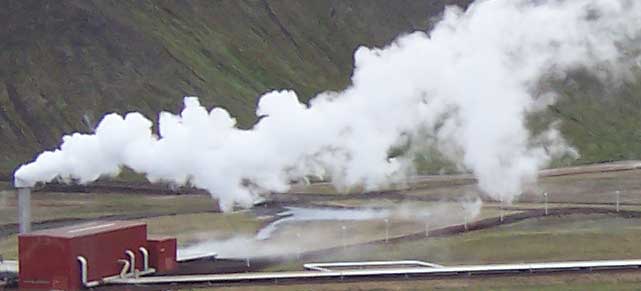
Part of this perception may come from the fact that while almost all of the steam produced from geothermal plants is water vapour, other particulates including hydrogen sulfide, sulfur dioxide, and carbon dioxide may be present in extremely low amounts. But these can be controlled and utilized in beneficial ways. The Blue Lagoon geothermal spa in Iceland is fed by the output of the nearby geothermal plant Svartsengi, and its warm waters are reputed to be therapeutic. The plant also uses a heat exchanger to heat the municipal water system.
A 2009 report by Northwestern University researchers found that geothermal has the least land use per generated power. “If that land was previously agricultural, most of the use could continue unabated,” says Dan Schochet, Executive Vice President of Ram Power, which operates the Meager Creek Hot Springs exploration project in B.C. (currently on hold).
David Gowland, Policy Director for Can- GEA, stresses the need for a long-term view, citing the short-term approach that has caused some Californian sites to run down the resource too quickly. “Countries like Iceland and New Zealand recognize they will be relying on the resource for the longterm so they draw out heat at a sustainable rate,” he says. “They are attuned to successfully managing the resource.”
Despite these benefits, until Canada has a commercial-scale geothermal operation, public awareness and demand will likely remain low.
Tim Weis compares the geothermal industry to a fledgling wind industry. “It really tipped the balance for wind energy when we got a couple of commercial projects in the ground,” he says. “Then that set the stage for substantial, long-term policies.”
Despite lagging behind our peers, Nicholas Heap of the David Suzuki Foundation thinks there’s still time for Canada to create “a planning and development system that makes low-impact renewables a core goal”.
“A lot can be done in a short time if there is the will to do it.”