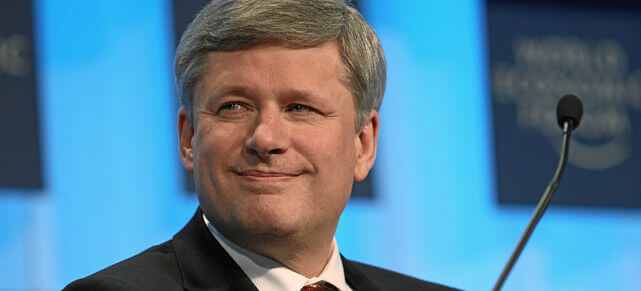
Yes, Stephen Harper now has a majority government. But he won only 40% of the popular vote and the NDPs won 31%. We also saw the election of Canada’s first ever Green Party MP when Elizabeth May made history.
I believe that there is an opportunity for Canadians to rethink its policy on climate change. The Green Party obviously understands the importance of protecting the planet but they also recognize the business case for environmental and climate protection. This is clearly articulated in their 2011 Vision Green Plan.
Two items from their plan directly relate to what I call Climate Capitalism: 1.) The Green Economy; and 2.) Averting Climate Catastrophe.
Under Harper’s watch Canada has gone from being considered a global thought leader regarding environmental protection to a perennial winner of the Fossil Award for the country frequently delaying progress on climate protection.
In 2002, Mr. Harper referred to the Kyoto Accord as a “socialist scheme to suck money out of wealth-producing nations.” Canada ratified the Kyoto Accord in 2002 but Harper, in a 2007 throne speech officially abandoned Canada’s commitment to Kyoto.
Mr. Harper has hired climate skeptics in the hopes of casting more doubt into Canadians’ minds about the validity of climate science.
The thing is, in the real world, there is no lingering doubt about climate science. Not amongst credible scientists anyway. You can always find people who have ulterior motives who will try to cast doubt on anything despite the evidence. Go back to the tobacco industry’s efforts to cast doubt on the undeniable evidence that excessive smoking can cause lung cancer.
But here’s the real problem with climate deniers. Frequently their ulterior motive is grounded in a concern that climate protection must necessarily be linked with job loss, economic decline and decreased competitiveness.
The problem with this reasoning is it is also not backed up by the evidence. Hunter Lovins and I recently published a book entitled Climate Capitalism which demonstrates what the Financial Times called “well supported examples of real business practice” across major industries such as transportation, agriculture, buildings and energy, how companies and communities are profiting from the transition to the low-carbon economy.
The Green Party has proposed a GHG reduction goal of 30% over 1990 levels by 2020, comparable to proposals on the table in Europe. The Harper government and conservative pundits such as Lorrie Goldstein of the Toronto Sun would have you believe that setting binding targets like that would be disastrous for our economy.
The evidence just does not support this claim. Goldman Sachs, not the treehugging type consultancy, has shown that companies who are leading in environmental, social and governance policies have share prices 25% higher than their counterparts. There are multi-billion low-carbon sectors operating in all major areas of our economy. How about low hanging fruit on energy efficiency. Companies like Wal-Mart (another treehugger right?) has installed a number of energy efficiency projects in their stores, distribution centres and with their fleets which are yielding hundreds of millions in savings each year.
I would like to propose a challenge to Mr. Harper. Let him bring any one of his leading climate skeptics, I mean environmental or economic advisors, to debate climate change and the economy with our newly elected Green Party leader, Elizabeth May, and myself. They choose the venue and format. Then we could let the Canadian public decide. I believe that if Canadians were informed about the economic benefits of climate protection, local and federal politicians would see that the Canadian population no longer wants to be the laughing stock of the international community. Canada could become a leader of the clean economy and show our neighbors to the South how it can be done at a profit.
Boyd Cohen is the CEO of CO2 IMPACT, a carbon origination company based in Vancouver, Canada and Bogota, Colombia. He is an adjunct professor at UBC and UVIC and is the co-author of Climate Capitalism: Capitalism in the Age of Climate Change.
Twitter hashtag #climatcaptlsm | Twitter: boydcohen