American economist and author Jeremy Rifkin considers the World Wide Web, and more broadly, the Internet, as an essential component of a future economic order called the Third Industrial Revolution, described in his latest book of the same name. There are five pillars that must be laid down before this new industrial revolution can be fully realized, he says. In no particular order, four of them are: 1) a shift to renewable energy; 2) conversion of building stock into micro-power plants; 3) deployment of energy storage technology in every building and throughout all infrastructure; and 4) converting the global transportation fleet into plug-in and fuel-cell vehicles that can buy and sell electricity via a smart and interactive power grid.
But the final pillar – the connectivity offered by the Internet and accessibility offered via the web – is arguably the most important. “The Third Industrial Revolution is a new convergence of communications and energy,” Rifkin explained in a recent chat with Corporate Knights. “This fundamentally changes the distribution of power and our relationship to energy and resources. And, of course, the Internet is a big part of this.”
Below is an edited excerpt from that discussion:
CK: Why are the web and Internet so essential to the emergence of the Third Industrial Revolution?
RIFKIN: It’s distributed and collaborative, and it scales not top down but to lateral power. So what’s interesting is you have 2.2 billion people out there who can now connect and send their own video and text each other with more distributed and collaborative potential, and we did that in (only) 25 years. Now we see the Internet merging with a new energy regime, which by nature is distributed energy. It’s a perfect fit.
CK: How so?
RIFKIN: Distributed energies are found in every square inch of the biosphere: the sun, wind, geothermal heat under the ground, agricultural and forestry residue and waste, ocean tides and waves, small hydro and garbage. These energies are literally found in some frequency and proportion everywhere. You cannot run a continental economy on centralized wind, solar and geothermal parks. It’s just not enough. But in the European Union alone we have 191 million buildings – homes, offices, factories. The goal is to convert every single building in the existing stock to be at least a partial micro-power plant.
CK: Similar to how we moved from big centralized computers in the 1970s to everyone owning their own today?
RIFKIN: Yes. Today we have a few power utility companies shipping us energy, but what we’re seeing – especially in Europe – is several million buildings producing a teeny bit of their own energy. In 10 years it will be tens of millions of buildings. In 25 years it will be hundreds of millions. We see it following the exact cost curve as the shift from mainframe to desktop computers to cell phones.
CK: So the pillar that represents the web and Internet is what ties this all together?
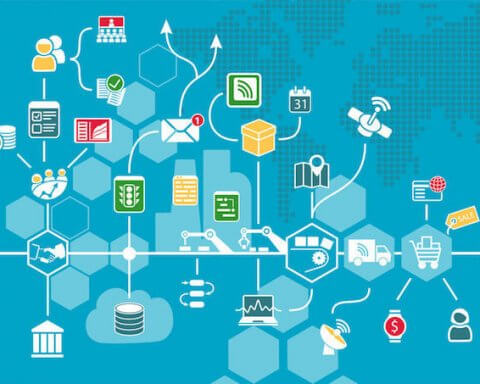
RIFKIN: It’s where the communications revolution really converges with the new distributed energies to create the nervous system for the infrastructure. So we take off-the-shelf Internet technology that exists today and convert the transmission of electricity to an ‘energy Internet’. The pillars by themselves are nothing. They are components. It’s only when you phase in and connect them with these synergies do you create a new living mega-technology platform – an infrastructure for the Third Industrial Revolution. The Internet and IT technologies create the synergies between those five pillars. We’re using the Internet to democratize energy.
CK: As you’ve outlined in great detail in your book, the Internet isn’t just having a profound impact on how we will produce and consume energy, but also on manufacturing, marketing and logistics. What about consumption of the goods we produce?
RIFKIN: We’re moving from ownership to access and from markets to networks. You have car sharing, couch sharing – everything is being shared. That’s really what’s happening here. Kids in my office don’t even think about owning a car. They think it’s a pain in the ass. The Third Industrial Revolution is the last of the great industrial revolutions. It sets up the framework for the beginning of the collaborative age.
CK: More collaboration and sharing would seem to mean less consumption and less centralized production. Won’t this have a big impact on labour markets?
RIFKIN: We eliminate mass wage labour as we move into intelligent technologies. But we do have one last gasp of mass wage labour. That’s to lay down the spike for the new infrastructure. In order to move to the new (distributed and renewable) energies, convert all of our buildings to power plants, put in storage across the infrastructure, and make the Internet an energy Internet, we create millions of jobs over 40 years. But once you bring in this smart infrastructure and it plateaus, you don’t need mass wage labour anymore.
CK: Are we capable of realizing this daunting vision?
RIFKIN: All of this is really difficult. It’s easy to talk about it, but it actually took us 20 years to get to this conversation. Getting it done requires a real enthusiasm. That enthusiasm has to move like the Internet moved. First, there was a bunch of strange people at the edge of society doing it, and then there was a point where the narrative took off in the 1990s when everybody could see this was something that they could get into. And it was pretty complicated setting up a whole IT and Internet communications infrastructure, but they did it pretty quickly. I think we’re at the narrative stage right now. It’s a matter of getting the Third Industrial Revolution into the public conversation.
CK: How will the Third Industrial Revolution unfold globally?
RIFKIN: Because it’s distributed and collaborative and scales laterally, it comes in nodally – like Wi-Fi. When Wi-Fi came in, it was problematic if you thought about it. Why would people go from garage to garage sharing their low frequency signals on the crappiest part of the wireless spectrum? But Wi-Fi went nodally house to house, neighbor to neighbor across continents, really quickly. What’s happening here is the Third Industrial Revolution is starting out of Europe and phasing in nodally. We’re seeing now that if Rome sets up a node, it immediately wants to find another node. If it has a surplus of green electricity because of weather conditions, it wants to share its electricity on the energy internet with Munich. Then if Munich has a surplus and Rome has a deficit, it wants to sell it back to them. You have to think that the Third Industrial Revolution likes to run uninhibited across land masses like Wi-Fi nodally until thousands of nodes connect to the ocean’s edge.
CK: Presumably centralized power and energy production, which marked the first and second industrial revolutions, makes this difficult.
RIFKIN: You can’t do it centralized. Even right now, at the end of the Second Industrial Revolution, 23 per cent of the human race has never had electricity. That’s the best you could ever do with a centralized model. And because fossil fuels are only going to get more expensive, and because of climate change, it’s pretty well over (for that approach). But renewables are found everywhere, even though they’ll scale continentally. In this way, whole continents become (self-contained energy) markets.
CK: Germany and the European Union in general seem to be on this path. North America, not so much. Can you explain why?
RIFKIN: President Barack Obama was for a green economy. He spent billions and billions of dollars of stimulus money on the green economy to no avail, because he spent it on isolated projects. He siloed them. He put money in a battery factory over here, financed a solar factory over there. Completely unconnected. He didn’t understand that economic revolutions require communications-energy matrixes to come together to create a nervous system, and then you have to create a whole infrastructure from that. Obama isolated all of these little standalone projects; therefore, no new jobs and no new economy. The challenge is daunting. It requires long-term infrastructure planning, and you have to have a social market model. The EU has the social market model; the U.S. doesn’t.
CK: If the right narrative does begin to emerge in North America, where do you think it will start?
RIFKIN: You’re seeing a de facto continental union emerge off the radar screen between the (Canadian) provinces and the northern states. The northeast states have a very strong formalized partnership with the eastern provinces, and the northwest states with the western provinces. The midwest group is very weak. What’s happening is there is a huge amount of interest in sharing energy, sharing education, sharing work skills and sharing university research institutions across the border. What we’re seeing is an organic intercontinental market starting to form, because remember that nodally the energy likes to flow to the next border. It just makes sense if you’re California, Oregon and Washington that you’re going to want to spread into British Columbia. So I think we’re beginning to see that, which I find very interesting because it’s not on any radar screen.
CK: Big energy utilities and the oligopolies that currently dominate the marketplace must be quite resistant to this vision, since it would spell their demise.
RIFKIN: We don’t want to collapse the old. We’re very clear with the companies in my group that we want to keep it on life support; we don’t want it to collapse. But we do want to put the investment in the new, and the key from a business point of view is how to stay in two portfolios at once so you can intelligently phase in a whole new infrastructure with a whole new multiplier effect that creates millions of jobs and thousands of businesses in a way where you don’t do it abruptly. That’s the toughest part of this whole thing, really. What’s clear is that you’re not going to see in 2050 three generations of kids who grew up with lateral power surrounded by old-fashioned nuclear power plants or tar sand pits. It’s just not the future.